MAQC2026 - Precision in a Complex World
Massive Analysis and Quality Control Society (MAQC) Society Annual Meeting
22–26 September 2026 | Brescia, Italy
LIGHT is pleased to host MAQC2026 - MAQC Society Annual Meeting, in Brescia, an international event dedicated to the quality, reproducibility, and reliability of data and methods in the life sciences.
The meeting will bring together the academic, clinical, regulatory, and industrial communities to discuss new frontiers in Artificial Intelligence and Machine Learning, omics, digital biomarkers, clinical research, and regulatory science, with a strong focus on data quality and on translating data into reliable applications.
Join MAQC2026
For more information, please viti:
MAQC2026 website
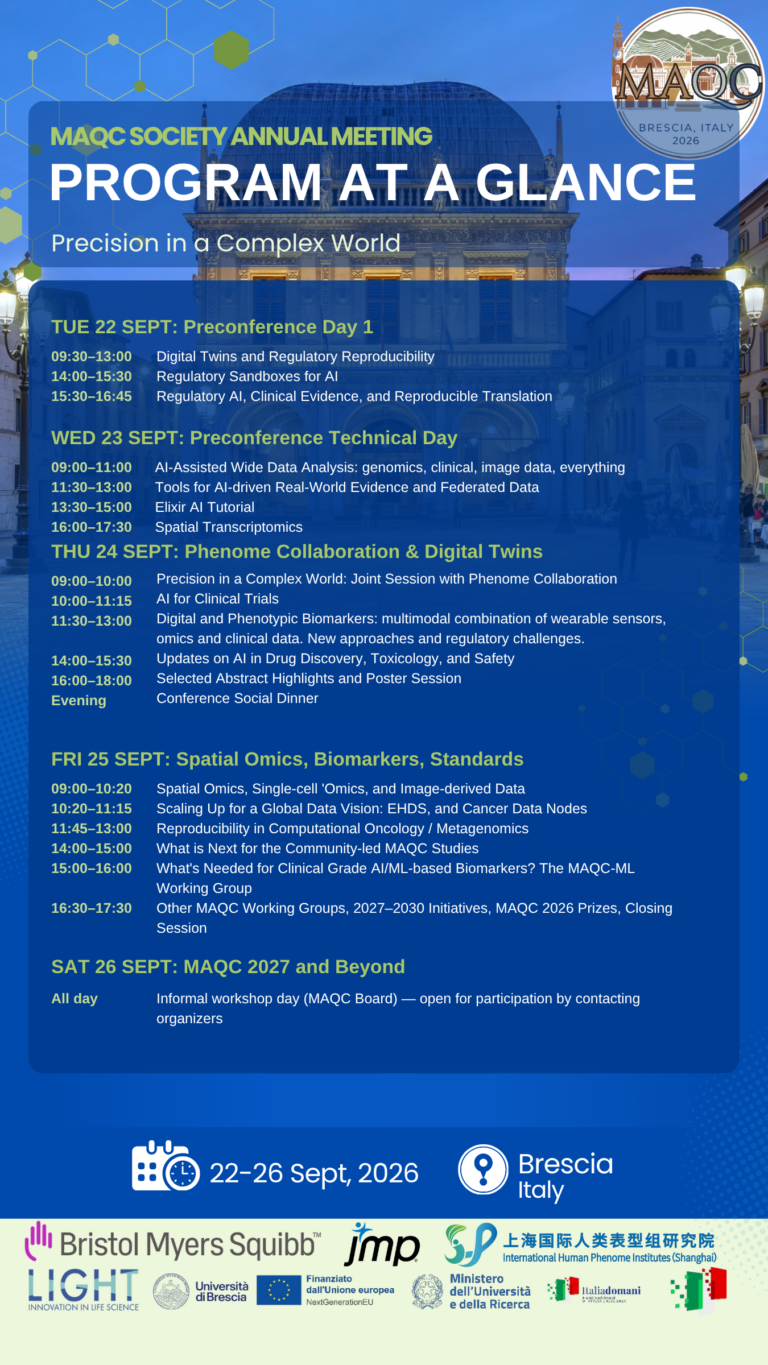
The event program can be found at the end of this article.
Precision in a Complex World
The program addresses key topics for the advancement of medicine and biomedical research, including AI for clinical trials and drug discovery, digital twins, regulatory AI, real-world evidence, single-cell and spatial omics, metagenomics, and AI/ML-based biomarkers.
Particular attention will be given to reproducibility, benchmarking, and data quality, with dedicated sessions focusing on the development of shared approaches and standards to make data and computational models more robust, reusable, and transferable to clinical and regulatory practice.
The program includes two pre-conference days dedicated to workshops and technical tutorials on September 22 and 23, followed by two conference days on September 24 and 25, featuring keynote lectures, scientific sessions, abstracts, and posters. The meeting will conclude on September 26 with a dedicated workshop focusing on future MAQC initiatives.
Key Topics:
The event will take place in Brescia from September 22 to 26 at the Department of Engineering of the University of Brescia. A workshop dedicated to future MAQC initiatives will be held on September 26
MAQC2026 is co-organized with the International Human Phenome Institute (IHPI) in Shanghai, under the patronage of the University of Brescia, and is supported by sponsors including Bristol Myers Squibb and JMP Statistical Discovery.